About 2-3 years ago I was a housing coordinator with a non-profit that operated 12 shelters and transitional homes for families experiencing homelessness. The shelters came fully stocked and included linens, a stocked kitchen for a family of 8, furniture, hygiene items like shampoo and new toothbrushes, plus house cleaning supplies. Moving people into the home was one of the greatest privileges and true joys. Touching moments, I’ll never forget. These were families who were living in a car, or staying in a hotel, one day and in one of our shelters the next. The home represented a chance, a step towards getting back what they lost. Emotions were high and tears no stranger.
You’d think all homeless families are the same, but this is not true. Each family had their own story and barriers. What they did have in common was they lived in a country with an unforgiving market. Meaning, that there was little room for mistakes. The system won’t care if you’re injured, or have no resources. Bing, Bang, Boom—no friends, no family, X,Y,Z happens, and the next thing you know you’re living in a car with your kids. When it happens, it will be ruthless, it will be fast.
Besides moving families in, another joy for me, which you may find surprising, was apartment turnarounds. After the old family moved out, the apartment had to be prepped for a new family. Often this was completed by a two-person team, me, and our maintenance guy. If we were lucky we could do it in a week. Sometimes we would have the assistance of volunteers. We’d muck it out, fix things, replace missing towels, bedsheets, appliances, etc. Get it fully stocked for the next family. It was fun setting up a new home, picking out color schemes, and matching found items with other found items, (probably because I was shopping with other people’s money.) The quicker we complete the turnaround the quicker we can help a new family, right? Plenty of incentives to be quick, efficient, and under budget. There are several stories I might share another time, but the point I want to share today, there were often copious amounts of clothes left behind. If you’ve ever raised children you know how quickly you go through clothes. Frequently turnarounds required a trip to the Goodwill both to drop off and to pick up.
POPPING TAGS
These days walking around my town’s Goodwill store, I am focused on finding bargains. I have an idea of what I’m looking for, maybe a new shirt, or bedsheets, I’m in and get the heck out. I don’t expect to spend more than $30 and I’m hoping to get about 5-10 items. With the cost of living at an all-time high, and used/unused clothes filling up landfills, it makes sense to buy used goods.
In 2023, Goodwill and other thrift stores have slowly increased the price of their goods.* Some thrifty shoppers have noticed prices are comparable to Target and Walmart — similar prices for items like boxer shorts and coffee cups BUT USED. GAG! What the heck? What is this about? After reading up it appears that there are three main reasons.
1) The price of renting retail space has gone up,
2) More people are shopping at thrift stores,
3) TikTok.
Wait… what? Yes, TikTok. Many people are posting online creations made from thrift store finds. Is this the 2023 recession equivalent of the 2020 pandemic sourdough bread baking? Why can’t a povvo like me, who is on a tight budget, get a break? Don’t take thrift stores from us, c’mon!
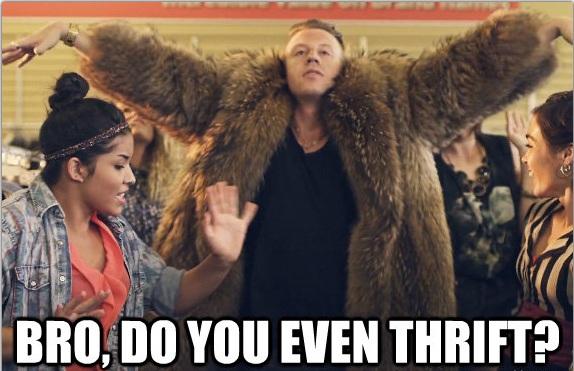
Macklemoor’s song “Thrift Shop” came out in 2012. According to officaldata.org, the dollar had an average inflation rate of 2.46% per year between 2012 and 2022, producing a cumulative price increase of 27.47%. This means that prices in 2022 are 1.27 times as high as average prices since 2012, according to the Bureau of Labor Statistics consumer price index. In other words, if you started with $20, you would need to end with $25.49 in order to “adjust” for inflation. Of course, it appears to be closer to $40. Regardless, in 2012 you got more tags to pop for less. Good times.
FAST FASHION
Below is a video that perhaps you didn’t catch when it came out earlier this year. Statistics have determined the average American wears a piece of clothing SEVEN times before donating it. What do thrift stores do with clothes they don’t sell? Many of them end up exported to countries in Africa. There are so many used clothes in a clothing trader market in Guyana that they call them “Dead White Man’s Clothes”. The idea behind this phrase is that a person must have died to be giving away so many clothes. Of course, it is excess, waste, and the dark side of goodwill.
*sources*
https://www.wsj.com/articles/thrift-store-prices-rising-cost-t-shirt-vintage-resellers-11652673305
https://finance.yahoo.com/news/goodwill-becoming-more-expensive-walmart-150225159.html
https://medium.com/the-reynolds-media-lab/why-are-thrift-store-prices-on-the-rise-18ec5d9b6307#:~:text=The%20popularity%20of%20thrifting%20has,a%20threat%20to%20thrift%20stores.
 shannon p. laws